




Key Points:
Date, Tithi & Fasting Details
- Date: Heramba Sankashti Chaturthi falls on Monday, August 31, 2026.
- Tithi Timing: Bhadrapada Krishna Chaturthi begins at 8:50 AM on August 31 and ends at 7:41 AM on September 1.
- Fast Observance: The fast lasts all day and is traditionally completed after local moonrise, moon darshan, offering arghya, and performing ritual worship.
Significance & Form of Ganesha
- Heramba Form: Dedicated to the five-headed (Panchamukhi) Heramba form of Lord Ganesha, associated with protection, courage, and overcoming severe obstacles.
- Astrological Relevance: Combines Ganesha worship for obstacle removal (Vighnaharta) with moon worship to balance emotions and alleviate planetary afflictions according to Jyotisha.
Introduction
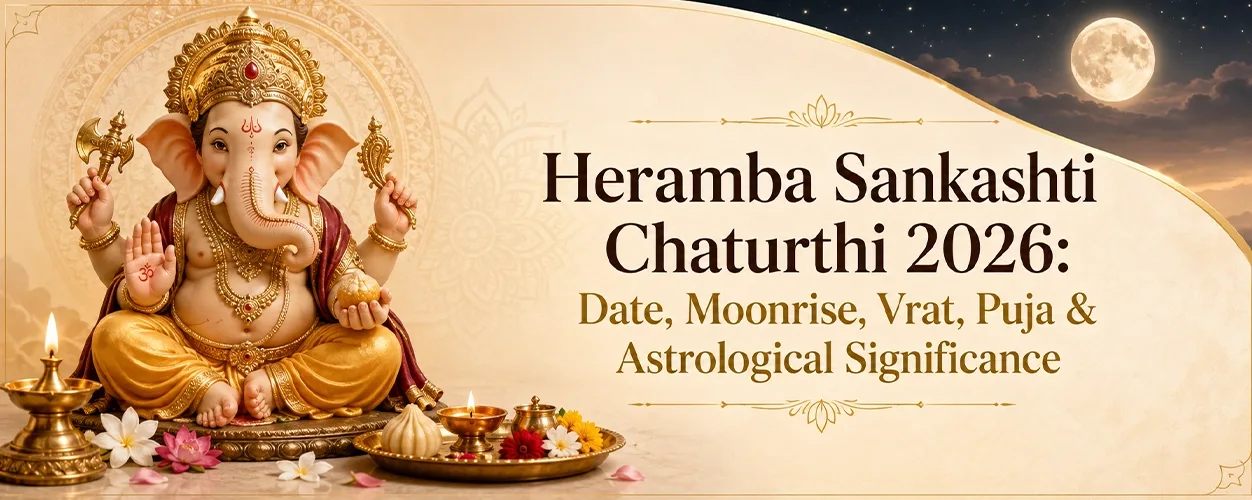
Heramba Sankashti Chaturthi is the Sankashti Chaturthi observed during Bhadrapada Krishna Paksha and dedicated to the Heramba form of Lord Ganesha. In 2026, it falls on Monday, 31 August.
The Chaturthi Tithi begins at 8:50 AM on 31 August and ends at 7:41 AM on 1 September; the fast is traditionally completed after Moonrise, making the local Moonrise time important for vrat observance.
This observance has a specific connection with Heramba Ganesha, whose five-headed form is traditionally associated with protection and overcoming difficult circumstances. The vrat combines fasting, Ganesha worship, moon darshan, arghya, and spiritual discipline.
Heramba Sankashti Chaturthi 2026: Date, Tithi & Moonrise Time
The Heramba Sankashti Chaturthi date is Monday, 31 August 2026. Panchang calculations identify this as Bhadrapada Krishna Chaturthi in the Purnimanta calendar; in the Amanta system, the same Chaturthi falls in Shravana Krishna Paksha.
The Heramba Sankashti tithi 2026 begins at 8:50 AM on 31 August and continues until 7:41 AM on 1 September. Sankashti fasting is traditionally completed after moonrise.
Hindu lunar observances can fall under different month conventions, so readers following other important observances in this period can also check the Shravan Somvar 2026 dates and vrat details.
| Detail | Information |
| Festival | Heramba Sankashti Chaturthi |
| Date & Day | Monday, 31 August 2026 |
| Tithi | Bhadrapada Krishna Chaturthi |
| Tithi Begins | 8:50 AM, 31 August |
| Tithi Ends | 7:41 AM, 1 September |
| Vrat Completion | After local Moonrise and Arghya |
| Presiding Deity | Heramba Ganesha |
What Is Heramba Sankashti Chaturthi?
Heramba Sankashti Chaturthi is a monthly Sankashti for Heramba Ganesha. Heramba Sankashti Chaturthi is observed on the fourth Tithi of Krishna Paksha and is celebrated with fasting and worship of Lord Ganesha. The word Sankashti is related to overcoming difficult situations or obstacles.
This observance is unique in that it is linked to the Heramba form of Ganesha Heramba is counted among the traditional 32 forms of Ganesha and is particularly associated with the protection of those who are vulnerable or facing difficult situations in their lives.
The Sankashti in August 2026 is thus of special significance for those devotees who seek a disciplined spiritual practice with a focus on protection, courage, and obstacle removal.
Who is Heramba Ganesha and why do we worship Him?
Heramba Ganesha is a special form of Lord Ganesha, traditionally depicted with 5 elephant heads and 10 arms. Heramba Ganesha is riding a lion instead of the mouse usually associated with Ganesha.
The five heads and multiple arms give this form a powerful protective iconography, while the lion represents strength and fearlessness. The name Heramba is traditionally interpreted in connection with the protection of the weak or helpless.
This symbolism explains why Heramba Ganapati is particularly associated with courage, protection, and overcoming difficult situations. Traditional sources also connect Heramba worship with difficult circumstances and describe its relevance within certain Tantric traditions.
For devotees, worshipping Heramba Ganesha on Heramba Sankashti places emphasis not only on removing obstacles but also on developing the inner steadiness required to face them.
Devotees who maintain a dedicated prayer space may also keep a Lord Ganesha frame as a devotional representation of Ganesha in their home.
Heramba Sankashti Chaturthi Vrat Rules and Fasting
The Heramba Sankashti vrat follows the traditional Sankashti pattern, with the fast continuing until Moonrise.
How to Observe the Vrat
- Take a bath and start the day with a clean and disciplined routine.
- Take a Sankalpa for observing the Sankashti fast.
- Worship Ganesha and offer Durva, flowers, and suitable naivedya.
- Maintain the chosen fasting practice during the day.
- Perform the main puja in the evening.
- Wait for moonrise and perform moon darshan.
- Give yourself to offering Arghya to the Moon.
- Complete the worship of Ganesha and break the fast as per the tradition.
What Can Be Eaten During the Fast?
Fasting practices vary by family and tradition. Common vrat foods include fruits, milk, potatoes, sabudana, and makhana, while many devotees avoid regular grains and foods not permitted during their chosen fast. You can do rituals according to your health.
When Is the Sankashti Fast Broken?
The Sankashti fast is traditionally broken after moonrise, following moon darshan and arghya. Because Moonrise varies by city, the local Panchang timing should be followed.
Heramba Sankashti Chaturthi Puja Vidhi
Heramba Sankashti Chaturthi Puja Vidhi can be performed at home as follows:
- Clean the puja place and place the Heramba Ganesha idol or image.
- Light a diya and incense.
- Offer Durva and flowers.
- Offer modak or Pedha.
- Chant a Ganesha mantra.
- Read or listen to the Sankashti Vrat Katha.
- Perform Ganesha Aarti.
- After Moonrise, offer Arghya.
- Complete the vrat after the prescribed worship.
Devotees who want to explore traditional mantra practices in greater detail can also read this guide to a powerful mantra.
Heramba Sankashti Chaturthi Vrat Katha and Mythological Significance
A traditional account connects Heramba Sankashti with Damayanti, who observed the fast on the advice of Maharishi Sharabhanga during a difficult period of separation from King Nala. The observance is described as helping her overcome that difficult circumstance and reunite with Nala.
The central lesson of this account is the role of disciplined devotion during adversity. It reflects the broader purpose of Sankashti: turning to Ganesha when obstacles become difficult to overcome and maintaining faith, discipline, and spiritual focus.

Significance of Heramba Sankashti Chaturthi
The significance of Heramba Sankashti can be understood through three connected aspects. Religiously, it is a Ganesha vrat associated with obstacle removal.
Heramba-specific worship adds the symbolism of protection, courage, and strength in difficult circumstances. Practically, the observance requires fasting, evening worship, Moon darshan, and Arghya, creating a structured spiritual discipline.
The five-headed Heramba form gives this Sankashti its distinctive identity, while the Moonrise-based completion connects the observance directly with the lunar cycle.
Astrological Significance of Heramba Sankashti Chaturthi
The astrological significance of Sankashti Chaturthi is particularly connected with the moon because the vrat culminates after moonrise. In Jyotisha, the Moon represents the mind, emotional responses, mental stability, and inner receptivity. Therefore, an observance that requires attention to moonrise naturally carries a strong lunar symbolism.
The Moon and Sankashti Chaturthi
Moon worship during Sankashti is traditionally connected with maintaining emotional discipline and mental focus. The purpose is not to claim that one vrat automatically changes the Moon’s astronomical or planetary condition but to use the lunar observance as a structured spiritual practice.
Ganesha and Obstacle Removal in Jyotisha
Ganesha is traditionally invoked before important undertakings and is associated with intelligence, discrimination, clarity, and removal of obstacles. Heramba’s specific symbolism adds protection and courage to these themes.
Devotees who maintain a dedicated prayer space may also keep a Lord Ganesha frame as a devotional representation of Ganesha in their home.
Readers interested in broader Vedic astrology topics can explore AstroInvite’s guides on planetary influences, Dashas, Kundli interpretation, and traditional Jyotisha concepts.
Can Sankashti Remedies Help With Planetary Afflictions?
Traditional Sankashti Chaturthi remedies are used as devotional practices alongside. This spiritual significance of Heramba Sankashti applies to devotees collectively, while the astrological interpretation of an individual’s planetary situation requires the complete birth chart.
Heramba Sankashti Remedies and Mantras
Remedy / Practice
| Remedy / Practice | Traditional Purpose |
| Ganesha Mantra Japa | Devotion, clarity and focused prayer |
| Durva Offering | Traditional Ganesha worship |
| Modak/Naivedya | Devotional offering |
| Moonrise Arghya | Completion of Sankashti observance |
| Charity | Generosity and service |
| Meditation | Mental discipline and reflection |
A simple Ganesha mantra such as “Om Gan Ganapataye Namah” can be included in regular japa according to one’s spiritual practice.
Rudraksha varieties are traditionally associated with different spiritual practices. Readers interested in understanding the different types of Rudraksha can explore their traditional classifications and uses.
Heramba Sankashti Chaturthi Dos and Don’ts
| Do | Don’t |
| Keep the puja space clean | Do not perform worship carelessly |
| Follow your chosen fasting tradition | Do not force an unsuitable restrictive fast |
| Complete the Moonrise ritual | Do not use another city’s Moonrise time |
| Offer traditional items respectfully | Do not treat regional customs as universal |
| Maintain prayer and discipline and have full faith. | Avoid anger, jealousy, and feelings of dissatisfaction |


