


Key Points:
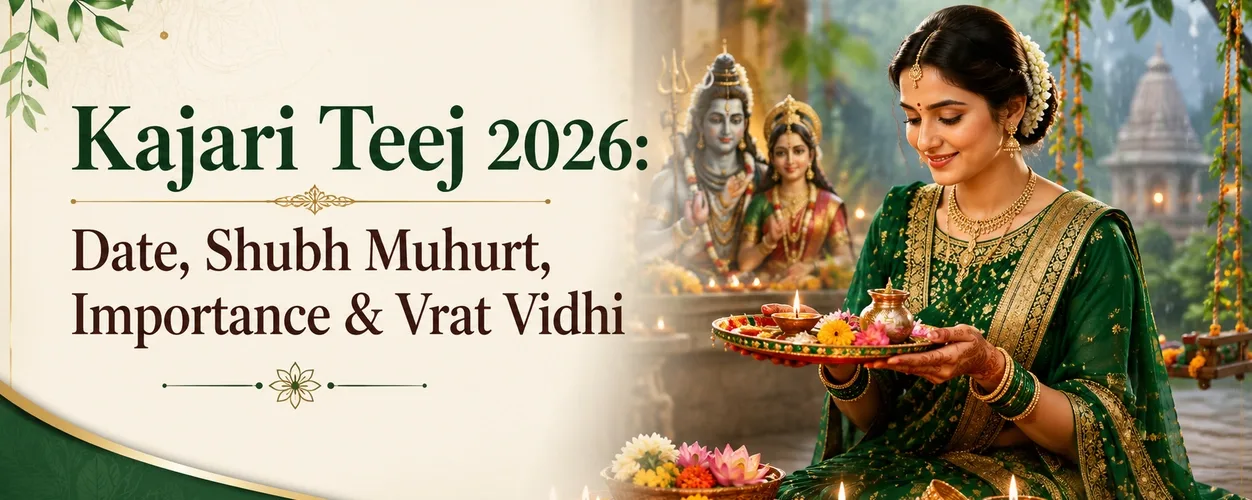
- Event & Date: Kajari Teej 2026 will be celebrated on Monday, August 31, 2026.
- Tithi Details: The Krishna Paksha Tritiya Tithi begins at around 9:36 AM on August 30 and ends at around 8:50 AM on August 31.
- Observance Reason: August 31 is chosen as the observance date in accordance with the Udaya Tithi calculation.
- Vrat Katha & Core Significance: The story centers on Goddess Parvati’s severe penance, determination, and unshakeable faith to win Lord Shiva as her husband. It highlights marital commitment, spiritual strength, and steadfast devotion.
- Target Observants:
- Unmarried women fast to seek a suitable life partner.
- Married women observe the fast to pray for marital harmony and the well-being of their spouses.
- Rituals & Traditions: Festivities include worshiping Neemdi Mata, performing Lord Shiva-Parvati puja, evening prayers, and making Chandra Arghya (moon offerings).
Introduction
Kajari Teej 2026 will be celebrated on Monday, August 31, 2026. The festival falls during Krishna Paksha Tritiya of the Bhadrapada month. One reason for confusion around the date is that the Tritiya Tithi begins on August 30 and continues into August 31. Therefore, August 30 marks the beginning of the Tithi, while August 31 is the festival observance date according to the applicable Udaya Tithi calculation.
This guide covers the Kajari Teej 2026 date, Tithi, Shubh Muhurat, Vrat Vidhi, Puja Samagri, Vrat Katha, regional traditions, and its significance from a Vedic astrology perspective.
Kajari Teej 2026 Date, Tithi & Shubh Muhurat
If you are searching for Kajari Teej kab hai, Kajari Teej kis tarikh ko hai, or Kajri Teej kab hai, the direct answer is Monday, August 31, 2026.
Based on Panchang calculations, the Krishna Paksha Tritiya begins at approximately 9:36 AM on August 30 and ends at approximately 8:50 AM on August 31.
| Detail | Kajari Teej 2026 |
| Festival | Kajari Teej |
| Date | Monday, August 31, 2026 |
| Tithi | Bhadrapada Krishna Tritiya |
| Tritiya Begins | August 30, 2026 |
| Tritiya Ends | August 31, 2026 |
| Observance | August 31, based on applicable Udaya Tithi |
| Main Deities | Shiva-Parvati, Neemdi Mata in traditions where worshipped |
Why Is Kajari Teej Celebrated on August 31, Not August 30?
The Krishna Paksha Tritiya starts on August 30, 2026, but it remains active on the morning of August 31. The Panchang system of observing festivals is based on the sunrise/Udaya Tithi principle; therefore, Kajari Teej is being celebrated on August 31 in the Indian calendar calculations taken here. So, August 30 is the Tithi beginning date, and August 31 is the festival observation date.
What Is Kajari Teej and Why Is It Celebrated?
Kajari Teej is observed on Krishna Paksha Tritiya of the Bhadrapada month in the North Indian calendar. It is one of the three widely recognized Teej observances along with Hariyali Teej and Hartalika Teej. It is especially associated with women’s fasting, Shiva-Parvati worship, and traditional prayers for marital well-being.
Married women traditionally observe the Kajari Teej vrat with prayers for the well-being and longevity of their husbands, while unmarried women may also observe the vrat with the traditional intention of seeking a suitable marital life.
The festival also has a strong cultural connection with monsoon celebrations, Kajri folk traditions, and community gatherings. In several regions, women participate in songs, swings, and festive activities alongside the religious observance.
Its religious framework naturally connects with themes of devotion, marriage, emotional balance, and Shiva-Parvati worship—subjects that can also be examined through a Vedic astrology perspective.
Kajari Teej Vrat: Rules, Fasting & Parana
The Kajari Teej vrat begins with personal preparation and a Sankalp and continues through the prescribed fasting and worship practices. The exact fasting method varies according to family and regional tradition.
How to Observe the Kajari Teej Vrat
- Take a bath in the morning and wear clean clothes.
- Take a Sankalp according to your family tradition.
- Establish or prepare the Puja space.
- Perform Shiva-Parvati worship with traditional offerings.
- Continue the chosen fasting practice during the day.
- Perform the evening Puja and listen to or read the Kajari Teej Vrat Katha.
- Follow Moon-related rituals or Chandra Arghya where they are part of the local tradition.
- Complete Parana according to the applicable family and regional practice.
Stage
- Morning: Bath, clean clothes, and Sankalp
- Daytime: Follow the chosen fasting practice
- Evening: Shiva-Parvati and traditional Neemdi Mata worship
- Moonrise: Chandra Arghya, as traditionally followed
- Parana: Break the fast according to applicable tradition
Some traditions observe a strict fast, while others permit certain foods during fasting. One form of fasting should not be presented as required for all, since there are regional and family customs.
Kajari Teej Puja Vidhi & Puja Samagri
For the Puja Vidhi of Kajari Teej, clean the worship area first and keep the required shashtra. Shiva-Parvati images or idols can be kept in the space allotted for Puja.
Devotees who follow Shiva-Parvati traditions may also consider Gauri Shankar Rudraksha as part of their personal spiritual practice.
Kajari Teej Puja Samagri
- Shiva-Parvati idol/image
- Water and traditional Puja vessel
- Flowers
- Belpatra for Shiva worship
- Durva was traditionally offered
- Roli and Akshat
- Incense and diya
- Fruits and sweets
- Traditional Shringar items where applicable
- Items required for Neemdi Mata worship as per local custom
Kajari Teej Puja Steps
- Clean the Puja space and arrange the Samagri.
- Invoke Lord Shiva and Goddess Parvati.
- Offer water, flowers, Belpatra, and other appropriate items.
- Perform the traditional Neemdi Mata worship as follows.
- Offer Naivedya and Shringar items according to family tradition.
- Read or listen to the Kajari Teej ki Katha.
- Perform Aarti and prayer.
- Complete any Moon-related ritual traditionally followed in your region.
Mantra recitation can also be part of devotional practice during Puja. Readers can explore this guide to a powerful mantra and its traditional uses.

Neemdi Mata Puja and Shiva-Parvati Worship on Kajari Teej
Neemdi Mata worship is an important feature of Kajari Teej traditions in some regions. The neem tree and its associated worship form part of the traditional ritual framework followed during the festival.
This practice should be distinguished from the broader Shiva-Parvati worship performed on Kajari Teej. Regional traditions may differ in how Neemdi Mata is represented, worshipped, and connected with the festival. Therefore, it is more accurate to describe Neemdi Mata worship as a regional/traditional component rather than claiming that every Kajari Teej observance follows the same Neemdi Mata ritual.
Kajari Teej Vrat Katha: The Story Behind the Festival
The Kajari Teej Vrat Katha is traditionally connected with devotion, marital commitment, and the spiritual importance of observing the vrat. Different regions preserve different versions of the Kajari Teej ki kahani, so a single narrative should not be presented as the only version followed throughout India.
The central religious theme is the importance of sincere devotion and disciplined observance. The worship of Shiva-Parvati gives the festival a marital and devotional context, while the vrat represents commitment and spiritual discipline.
The Kajari Teej vrat katha is traditionally associated with the devotion of Goddess Parvati towards Lord Shiva. According to the popular traditional narrative, Goddess Parvati performed intense penance and observed severe austerities to attain Lord Shiva as her husband. Her devotion continued through several births, reflecting her determination, patience, and unwavering faith. Pleased with her devotion and spiritual discipline, Lord Shiva accepted her as his consort. This story is remembered on Kajari Teej as a symbol of steadfast devotion, marital commitment, and the spiritual strength associated with the Shiva-Parvati relationship.
The Kajari Teej ki kahani, therefore, holds particular importance for women observing the vrat. Married women traditionally pray for the well-being and harmony of their married life, while unmarried women may observe the vrat with the traditional intention of seeking a suitable life partner. In many regional traditions, Kajari Teej is also connected with Neemdi Mata worship and evening rituals, followed by prayers and, where customary, Chandra Arghya. The exact details of the Kajari Teej vrat katha and its ritual presentation can vary across regions, but the central message remains devotion, patience, faith, and the strength of the Shiva-Parvati bond.
The Shiva-Parvati tradition is also associated with several spiritual symbols and practices. Readers interested in one such traditional symbol can learn more about Gauri Shankar Rudraksha, including its significance and wearing practices.
Astrological Significance of Kajari Teej
In Vedic astrology, the Moon is associated with the mind, emotions, inner peace, and mental stability. Kajari Teej falls during Krishna Paksha, the waning phase of the Moon, making lunar symbolism particularly relevant to the festival’s devotional practices. The period is traditionally associated with introspection, emotional discipline, and turning inward through prayer and fasting.
The Shiva-Parvati tradition adds another important astrological layer to Kajari Teej. Their union is widely regarded as a symbol of marital harmony, devotion, and balance between complementary energies. Observing the vrat and performing devotional practices are therefore traditionally connected with prayers for relationship stability, emotional well-being, and family harmony.
Fasting and Chandra-related worship can also be understood symbolically through the Moon’s association with emotional regulation. Devotional practices performed during a specific Tithi are interpreted within the broader Panchang framework, where the lunar day forms part of the timing used for religious observances.
However, these are general astrological interpretations. The effect of a festival or its rituals can differ from one person to another based on the Moon’s sign, house, Nakshatra, planetary aspects, and other factors in the individual Kundli. Therefore, general Rashi-level guidance should not be treated as equivalent to personalized Kundli analysis.
Traditionally, Kajari Teej is therefore understood through the combined themes of the Moon, devotion, fasting, relationships, and lunar timing, rather than as a universal remedy for every planetary difficulty.
Readers interested in related topics can explore more guides on Vedic astrology, planetary influences, Rashi, and other traditional astrology concepts on AstroInvite.
Kajari Teej Remedies According to Rashi
Rashi-based guidance can be used only as general spiritual guidance, not as a substitute for individual Kundli analysis.
To better understand Rashi-based guidance, readers can first learn what Rashi is in astrology and how it is interpreted in a birth chart.
| Rashi | Traditional Focus | Suggested Spiritual Practice |
| Aries | Patience and harmony | Shiva-Parvati prayer |
| Taurus | Emotional steadiness | Chandra-focused prayer |
| Gemini | Communication | Ganesha/Shiva mantra |
| Cancer | Emotional balance | Moon-related worship |
| Leo | Balance and humility | Shiva worship |
| Virgo | Mental clarity | Prayer and disciplined observance |
| Libra | Relationship harmony | Shiva-Parvati Puja |
| Scorpio | Emotional control | Mantra and meditation |
| Sagittarius | Devotion and Dharma | Prayer and charity |
| Capricorn | Stability | Shiva worship |
| Aquarius | Emotional grounding | Meditation and mantra |
| Pisces | Spiritual balance | Devotional prayer |
These are broad traditional frameworks. A personalized remedy should consider the Ascendant, Moon sign, planetary placements, houses, and relevant Dashas rather than assigning a planetary remedy solely from the Rashi.
Other Names and Regional Traditions of Kajari Teej
Kajariya Teej, Kajri Teej, Kajli Teej, Badi Teej, and Satudi Teej are names associated with Kajari Teej in different regions. Sources also use spellings such as Kajali Teej and Kajri Teej.
The festival has particularly strong traditional associations with parts of Rajasthan, Uttar Pradesh, Madhya Pradesh, and Bihar. Kajri folk songs, community celebrations, and local Kajari Teej mela traditions add a distinct cultural dimension to the religious observance.
Kajari Teej vs Hariyali Teej vs Hartalika Teej
| Hariyali Teej | Monsoon and Shiva-Parvati | Teej vrat and celebration |
| Kajari Teej | Monsoon and marital devotion | Shiva-Parvati, regional Neemdi Mata and Moon-related rituals |
| Hartalika Teej | Parvati’s penance | Shiva-Parvati worship and fasting |
The three festivals belong to the broader Teej tradition but have different dates, stories, and regional observances. Kajari Teej should therefore not be treated as another name for Hariyali Teej or Hartalika Teej.


