




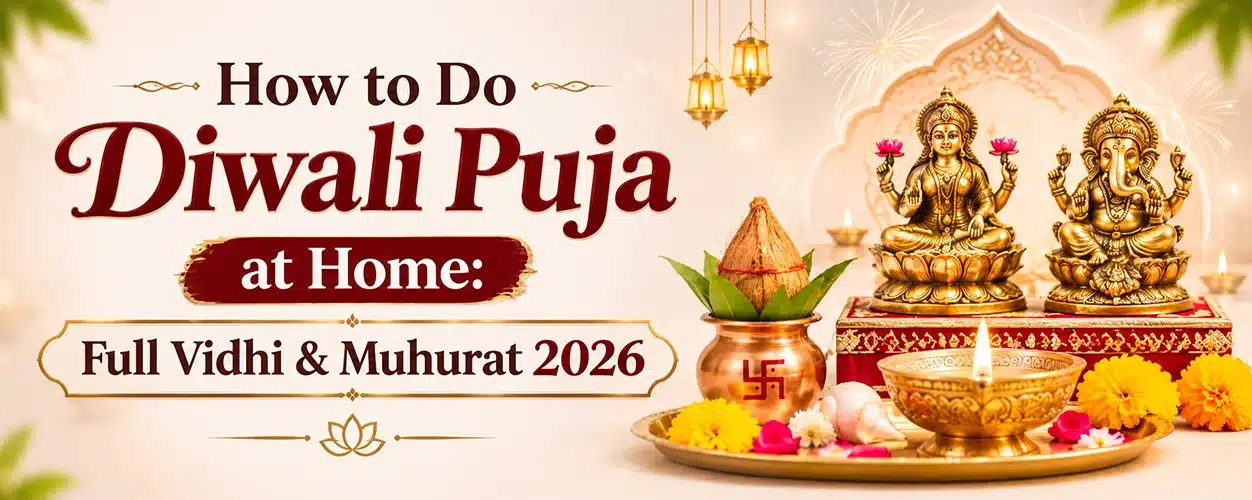
Diwali 2026 falls on Sunday, 8 November, and the auspicious Lakshmi Puja muhurat is 5:54 PM to 7:50 PM in New Delhi and 5:54 PM to 7:49 PM in Noida. To perform Diwali puja at home, clean the worship area, arrange the puja samagri, take a sankalp, worship Lord Ganesh and Goddess Lakshmi, offer flowers and sweets, chant the mantras, and conclude with aarti and prasad.
Diwali, also known as Deepavali, is one of the most important Hindu festivals. Homes are decorated with rangoli, illuminated with diyas, and filled with prayers for happiness, wisdom, and prosperity.
At the heart of Diwali celebrations is Lakshmi Ganesh Puja. Goddess Lakshmi is worshipped for wealth and auspiciousness, while Lord Ganesh is revered for wisdom and the removal of obstacles.
If you are wondering how to do Diwali puja at home, this guide covers the essential preparations, Diwali 2026 muhurat, complete practical household puja vidhi, important mantras, traditional rituals, and common mistakes to avoid.
The procedure follows common Hindu household traditions. More elaborate Shastriya ceremonies may include additional offerings, invocations, and mantras.
Diwali 2026 Date and Shubh Puja Muhurat
Diwali Lakshmi Puja will be celebrated on Sunday, 8 November 2026, during Kartik Amavasya according to the North Indian Hindu calendar.
Lakshmi Puja is traditionally performed during Pradosh Kaal, preferably when Vrishabha Lagna, a fixed or sthir lagna, is rising.
The recommended Lakshmi Puja muhurat for New Delhi is 5:54 PM to 7:50 PM.
Diwali 2026 Panchang Details for New Delhi
| Panchang Detail | Date and Timing |
| Diwali Date | Sunday, 8 November 2026 |
| Amavasya Tithi Begins | 11:27 AM, 8 November |
| Amavasya Tithi Ends | 12:31 PM, 9 November |
| Pradosh Kaal | 5:31 PM to 8:09 PM |
| Vrishabha Lagna | 5:54 PM to 7:50 PM |
| Lakshmi Puja Muhurat | 5:54 PM to 7:50 PM |
Diwali Puja Muhurat 2026: City-Wise Timings
| City | Lakshmi Puja Muhurat |
| New Delhi | 5:54 PM to 7:50 PM |
| Noida | 5:54 PM to 7:49 PM |
| Gurugram | 5:55 PM to 7:51 PM |
| Chandigarh | 5:52 PM to 7:46 PM |
| Jaipur | 6:03 PM to 7:59 PM |
| Ahmedabad | 6:22 PM to 8:20 PM |
| Mumbai | 6:27 PM to 8:27 PM |
| Pune | 6:24 PM to 8:24 PM |
| Hyderabad | 6:07 PM to 8:08 PM |
| Bengaluru | 6:17 PM to 8:20 PM |
| Chennai | 6:07 PM to 8:09 PM |
| Kolkata | 5:20 PM to 7:18 PM |
All timings are in Indian Standard Time (IST) and are calculated for the respective cities.
The Diwali puja muhurat varies by location because sunset and lagna timings differ. Check your city’s Panchang before beginning the ceremony.
For a longer household puja, preliminary preparations and rituals may begin before the main muhurat so that the principal Lakshmi worship takes place during the preferred period.
Why Are Lakshmi and Ganesh Worshipped on Diwali?
The worship of Goddess Lakshmi and Lord Ganesh is a significant tradition in many Hindu households.
Goddess Lakshmi: Prosperity and Auspiciousness
Goddess Lakshmi is traditionally worshipped as the deity of wealth, prosperity, abundance, and good fortune.
On Diwali, devotees pray for their family’s welfare, financial stability, and an auspicious year ahead.
Her worship is also associated with cleanliness, gratitude, and maintaining a harmonious household.
Lord Ganesh: Wisdom and Removal of Obstacles
Lord Ganesh is revered as Vighnaharta, the remover of obstacles.
He is associated with wisdom, knowledge, and auspicious beginnings. This is why many Hindu worship ceremonies begin with prayers to Lord Ganesh.
Significance of Lakshmi Ganesh Puja
The combined worship of Goddess Lakshmi and Lord Ganesh symbolizes the importance of prosperity accompanied by wisdom.
Devotees pray not only for abundance but also for the ability to make responsible decisions and maintain harmony within their families.
These interpretations are rooted in Hindu religious traditions and devotional beliefs.
Diwali Puja Samagri List
Before beginning the Diwali puja vidhi at home, arrange the essential worship items.
Keeping the samagri ready helps families perform the rituals without unnecessary interruptions during the auspicious muhurat.
| Puja Samagri | Used For |
| Lakshmi and Ganesh idols or pictures | Main worship |
| Wooden chowki and red or yellow cloth | Preparing the altar |
| Kalash, clean water, mango leaves, and coconut | Kalash Sthapana |
| Ganga Jal | Ritual purification |
| Roli, kumkum, haldi, and chandan | Tilak and offerings |
| Akshat (unbroken rice) | Traditional offerings |
| Fresh flowers and garlands | Offering to the deities |
| Ghee or oil diya with cotton wicks | Lighting the puja lamp |
| Dhoop, incense sticks and camphor | Dhoop and aarti |
| Sweets and fruits | Naivedya and prasad |
| Paan and supari | Traditional tambul offerings |
| Coins and other auspicious items | Lakshmi and Kuber worship |
| Aarti thali and bell | Performing aarti |
Some households also include a Kuber Yantra, a Saraswati image, new account books, or other customary materials.
The exact offerings may differ according to regional and family traditions.
How to Do Diwali Puja at Home: Step-by-Step Vidhi
The following Diwali puja vidhi at home explains a practical worship sequence suitable for families performing Lakshmi Ganesh Puja.
A detailed traditional ceremony may include purification rites, Sankalp, Kalash Sthapana, Ganesh Puja, Lakshmi Puja, Saraswati Puja, Kuber Puja, and Deep Malika Puja.
The steps below cover the main household worship from preparation to concluding prayers.
Before Starting the Puja
- Clean the puja room and main entrance.
- Decorate the entrance with rangoli, flowers, and diyas.
- Bathe and wear clean clothes before beginning worship.
- Cover a wooden chowki with a clean red or yellow cloth.
- Place Goddess Lakshmi and Lord Ganesh idols or pictures on the altar.
- Arrange the kalash, flowers, sweets, diya, and aarti thali nearby.
Step 1: Purify Yourself and the Puja Space
Sit in front of the altar.
Sprinkle a little Ganga Jal on yourself, the puja materials, and the worship area.
Light the main ghee diya.
Offer a short prayer and focus your attention on the worship.
Step 2: Take the Sankalp.
Sankalp expresses your intention to perform the puja.
Hold water, Akshat, and a flower in your right hand.
State your name, gotra if known, and your intention to worship Goddess Lakshmi and Lord Ganesh for your family’s welfare and prosperity.
Release the water in front of the altar.
A formal Sankalp Mantra may also be recited when following an elaborate traditional procedure.
Step 3: Perform Kalash Sthapana.
Fill a clean kalash with water.
Add Akshat and other prescribed items according to your family tradition.
Place mango leaves at the mouth of the kalash and position a coconut on top.
Kalash Sthapana is traditionally associated with auspiciousness and the invocation of divine presence.
Step 4: Worship Lord Ganesh
Begin the Lakshmi Ganesh puja vidhi with prayers to Lord Ganesh.
Offer flowers, akshat, chandan, and suitable sweets.
Ganesh Mantra
ॐ गं गणपतये नमः॥
Om Gam Ganapataye Namah
Chant the mantra with devotion and pray for wisdom, harmony, and the removal of obstacles.
Step 5: Perform Goddess Lakshmi Puja
Goddess Lakshmi is the principal deity worshipped during the Diwali evening ceremony.
Begin by meditating upon Goddess Lakshmi and offering prayers to invite her divine presence.
Offer flowers, akshat, chandan, incense, a diya, fruits, and sweets according to your family tradition.
Lakshmi Mantra
ॐ श्रीं महालक्ष्म्यै नमः॥
Om Shreem Mahalakshmyai Namah
Chant the mantra while praying for prosperity, auspiciousness, and the welfare of your household.
The main steps of a simplified Lakshmi puja vidhi include
- Meditate upon Goddess Lakshmi.
- Offer flowers and akshat.
- Apply chandan or kumkum where customary.
- Offer incense and light a diya.
- Offer sweets, fruits, and other suitable naivedya.
- Recite Lakshmi mantras or prayers.
- Seek blessings for the family.
A more elaborate Shodashopachara Lakshmi Puja includes sixteen ceremonial offerings and their associated invocations.
Families following an elaborate ritual may include additional steps such as Avahana, Asana, Padya, Arghya, Achamana, Snana, Vastra, Gandha, Pushpa, Dhupa, Deepa, and Naivedya, followed by concluding offerings according to their tradition.
Step 6: Worship Lord Kuber
Lord Kuber is traditionally associated with wealth and its safekeeping.
In households that include Kuber Puja, flowers, akshat, chandan, and a lamp may be offered before a Kuber image, yantra, or cash box.
Kuber Mantra
ॐ यक्षाय कुबेराय वैश्रवणाय धनधान्याधिपतये धनधान्यसमृद्धिं मे देहि दापय स्वाहा॥
Om Yakshaya Kuberaya Vaishravanaya Dhanadhanyadhipataye Dhanadhanyasamriddhim Me Dehi Dapaya Svaha
This mantra is traditionally recited as a prayer for prosperity and abundance.
Step 7: Offer Naivedya and Perform Aarti
After completing the main worship, offer sweets, fruits, and other prepared naivedya to the deities.
Perform Lakshmi Ganesh Aarti using a diya or camphor.
Some families also recite the Shri Suktam, or traditional Lakshmi aarti.
Step 8: Seek Forgiveness and Distribute Prasad
Fold your hands and express gratitude.
Pray for forgiveness for any unintentional mistakes made during the worship.
Distribute the offered prasad among family members.
After the main puja, families traditionally light additional diyas around the home as part of Diwali celebrations.
Important Mantras for Diwali Puja at Home
Mantras form an important part of Diwali worship. The following three devotional mantras are used during the household puja described above.
| Deity | Mantra |
| Lord Ganesh | ॐ गं गणपतये नमः॥ |
| Goddess Lakshmi | ॐ श्रीं महालक्ष्म्यै नमः॥ |
| Lord Kuber | ॐ यक्षाय कुबेराय वैश्रवणाय धनधान्याधिपतये धनधान्यसमृद्धिं मे देहि दापय स्वाहा॥ |
These mantras can be recited during their respective worship steps.
A full Shastriya Puja may include additional Sankalp, Dhyana, Avahana, sixteen offerings, and concluding mantras.
The three mantras above are intended for a practical household worship guide rather than an exhaustive collection of formal ritual recitations.
Important Traditions During Lakshmi Ganesh Puja
Several customs are associated with Diwali worship across different Hindu communities.
Saraswati Puja
Some families include prayers to Goddess Saraswati, who is associated with knowledge and learning.
Books, writing materials and educational items may be placed near the altar according to family customs.
Bahi-Khata Puja
In many traditional business communities, account books and financial records are worshipped during Diwali.
This practice is especially associated with business communities where the festival marks an auspicious beginning for financial records.
Deep Malika Puja
Deep Malika refers to the worship and arrangement of lamps.
Lighting rows of diyas is one of the most recognizable Deepavali traditions.
Families traditionally place lamps near the puja area, entrance and other suitable locations in the home.
Shri Suktam and Lakshmi Aarti
Some families recite the Shri Suktam or Lakshmi Stuti after the main worship.
Others conclude with traditional Lakshmi Ganesh aarti.
These devotional practices vary depending on family and regional traditions.
Why Is Pradosh Kaal Important for Diwali Puja?
Pradosh Kaal is the evening period beginning around sunset.
According to traditional Hindu almanacs, Lakshmi Puja is especially auspicious when Amavasya tithi is present during Pradosh Kaal.
A fixed or sthir lagna is also preferred in several astrological traditions.
Importance of Vrishabha Lagna
Vrishabha Lagna is classified as a fixed lagna in Vedic astrology.
It is traditionally considered favourable for worship associated with lasting prosperity and stability.
For New Delhi, the preferred Vrishabha Lagna on Diwali 2026 is from 5:54 PM to 7:50 PM.
This period is recommended for evening Lakshmi Puja according to the Drik Panchang calculation used in this guide.
These timings reflect religious and astrological traditions rather than scientifically established predictions of financial outcomes.
Common Mistakes to Avoid During Diwali Puja
Preparing in advance can make your household worship more organized and meaningful.
1. Not Checking Your City’s Puja Muhurat
The auspicious timing is not the same across India.
Always use a Panchang calculated for your location.
2. Arranging Samagri at the Last Moment
Prepare the altar and collect the necessary offerings before the main puja muhurat begins.
3. Confusing a Simple Home Puja with an Elaborate Ceremony
A simplified household ceremony does not include every step of the detailed Shastriya Puja.
For a more elaborate ceremony involving formal mantras and offerings, consult a traditional puja text or knowledgeable priest.
4. Assuming Every Regional Tradition Is Compulsory
Household practices vary across Hindu communities.
Offerings, worship order and customs may differ according to family traditions.
5. Ignoring Diya and Camphor Safety
Place diyas on stable, non-flammable surfaces.
Keep flames away from curtains and decorations, and do not leave them unattended.
Dhanteras Puja and Its Connection with Diwali
Dhanteras marks the beginning of the Diwali festive period in many Indian households.
In 2026, Dhanteras falls on Friday, 6 November, while the main Diwali Lakshmi Puja takes place on Sunday, 8 November.
Dhanteras is associated with the worship of Lord Dhanvantari, Goddess Lakshmi and Lord Kuber, along with the Yama Deepam tradition.
Diwali Lakshmi Puja focuses especially on Goddess Lakshmi and Lord Ganesh during the auspicious Amavasya evening.
If you are preparing for both festivals, read Astro Invite’s guide on dhanteras puja at home to understand the Dhanteras samagri, muhurat, puja steps and traditional mantras.
Plan Your Diwali with Astro Sachin Pandit
Diwali is a time for worship, reflection and auspicious beginnings.
For those interested in Vedic astrology, a personalized kundli consultation can help explore traditional astrological interpretations of planetary influences, auspicious dates and important decisions.
If you are looking for the best astrologer in India for consultation, you can connect with Astro Sachin Pandit, who has over 30 years of experience in Vedic astrology, Lal Kitab, numerology and palmistry.
Call / WhatsApp: 9971230555 | 9315926721
Disclaimer: The religious practices and astrological interpretations described in this article are based on Hindu traditions and beliefs. They are shared for devotional and informational purposes and do not guarantee financial, medical or other personal outcomes.
Sources
Sources checked on 4 November 2026
- Drik Panchang: Diwali Lakshmi Puja Timings 2026 (Diwali date, Amavasya tithi, Pradosh Kaal and city-wise puja timings)
- Drik Panchang: Diwali Puja Muhurat Based on Fixed Lagna (Vrishabha Lagna and auspicious timing)
- Drik Panchang: Detailed Diwali Puja Vidhi (traditional puja sequence and worship practices)
- Drik Panchang: Shodashopachara Lakshmi Puja Vidhi (Lakshmi worship and ceremonial offerings)
- Drik Panchang: Kuber Mantras (traditional Kuber mantra)


